What Are “Local Rules” (False Rules)?
The Relational Structures That Cause Chronic Suffering
In clinical practice, a recurring pattern often emerges beneath the persistent distress clients describe. Regardless of the specific symptoms, there is frequently a shared relational structure sustaining their long-term suffering.
As a Certified Public Psychologist specializing in trauma therapy, I have explored these structures in my books, including Developmental Trauma: The Real Cause of “Ikizurasa” (Japanese term meaning “chronic distress” or “difficulty in living”) (Discover Twenty One, 2023). In this blog, I aim to present insights from clinical settings in a form that is both precise and accessible.
In this article, I examine one core structure underlying chronic distress: “Local Rules” (False Rules).
Persistent Distress That Does Not Fade
Clients often report experiences such as:
“I can’t shake this heavy, gloomy feeling.”
“I lack confidence for no clear reason.”
“I always end up being overly accommodating or submissive.”
“There are certain people I find impossible to deal with.”
These are common themes in counseling. While therapeutic work can alleviate specific symptoms, the underlying sense of “difficulty in living” (ikizurasa) often remains stubbornly intact.
Many individuals suffer in this way for years without understanding why.
The reason lies in a particular structure: the internalization of Local Rules (False Rules).
What Are “Local Rules” (False Rules)?
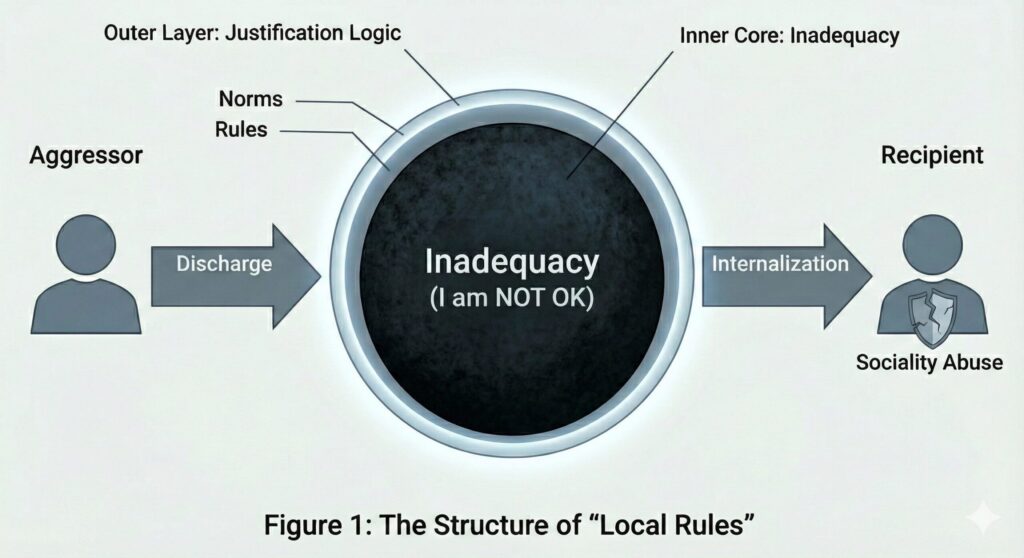
A Local Rule is a state of Inadequacy imposed on others, disguised as something reasonable—such as a rule, norm, or common sense. Although it appears legitimate on the surface, it is, in fact, a projection of another person’s unresolved Inadequacy.
Here, Inadequacy refers to an internal state characterized by:
- a sense that one’s existence is not acknowledged
- a feeling of being unloved
- a feeling of fundamental rejection
This state commonly arises from attachment anxiety, trauma, or chronic stress. In simple terms, it corresponds to the inner conviction: “I am not OK.”
During development, humans require attuned care to form a sense of safety and self-worth. When this process is disrupted—through maltreatment, family dysfunction, or bullying—Inadequacy becomes deeply embedded.
The pain of “I am not OK” is often intolerable without care. As a result, many seek temporary relief by involving others—forcing them to absorb the message: “You are not OK.”
When an individual cannot reach an “I am OK” state through healthy development, they may attempt to achieve it relationally by positioning others as “not OK.”
The Mechanism of Sugar-Coated Poison
Directly projecting one’s Inadequacy would be socially rejected. Therefore, it is coated with logic:
“This is the rule.”
“This is common sense.”
“You are the one who is strange.”
While these statements appear reasonable, their core is toxic. They function as sugar-coated poison.
The recipient is compelled to swallow this poison—the other person’s Inadequacy—and carry it internally, often for years.
This Inadequacy frequently contains traces of the perpetrator’s own past experiences of domination or powerlessness. As a reversal, they seek control by imposing hierarchy.
Thus, Local Rules are not merely expressions of frustration; they are mechanisms for producing dominance and relational inequality, often operating semi-unconsciously.
Why Do We Swallow Local Rules?
Humans as Social Beings (Zoon Politikon)
One might ask: Why not simply refuse them?
In reality, this is profoundly difficult.
Humans are fundamentally social beings (zoon politikon). We are oriented toward maintaining relationships and adhering to shared norms. This makes us especially vulnerable to anything framed as “common sense” or “the rule.”
Rejecting a Local Rule risks social exclusion—being labeled “abnormal” or “problematic.” Challenging it requires not only reasoning, but the willingness to risk the relationship itself.
As a result, many people suppress their intuition and swallow the sugar-coated poison.
Using Mistakes as a Pretext
Local Rules are often enforced through minor behavioral mistakes.
In workplaces, for example, a supervisor may seize upon a small error to impose personal values or discharge their Inadequacy under the guise of “guidance.” Although a mistake occurred, the disproportionate reaction is rarely about the work itself—it is a convenient pretext for control.
The same structure appears in school bullying. Differences in ability or personality are used to label someone as “inferior,” forcing them to internalize unjust treatment. Teachers and parents may also be drawn into this logic, rationalizing the situation by attributing blame to the victim.
Intergenerational Transmission Within Families
These dynamics are not limited to institutions; they occur within families as well.
Because trauma and attachment anxiety are often intergenerational, parents may carry unresolved Inadequacy themselves. Under the banner of discipline or education, they may impose it upon their children.
A child’s spontaneity can trigger a parent’s repressed self, provoking fear or aversion. Some parents go further, controlling education or career choices “for the child’s sake,” while unconsciously compensating for their own unfulfilled lives.
Children who internalize such Local Rules may grow up living as a False Self, experiencing chronic emptiness despite apparent functionality.
The Trap of Internalization: Sociality Abuse
The most dangerous aspect of Local Rules is internalization.
Children, driven by their innate sociality and desire to be loved, often misinterpret rejection as:
“I am being punished because I am a bad child.”
This exploitation of sociality and goodness is what I call Sociality Abuse. Its effects frequently persist into adulthood as trauma symptoms:
- chronic self-negation
- hyper-adaptation and constant tension
- loss of an internal sense of self
This leaves individuals particularly vulnerable to new authority figures who impose further Local Rules.
A New Perspective on Modern Structures of Suffering
Viewing distress through the lens of Local Rules reveals the hidden structures behind everyday unfairness. It deepens our understanding of harassment by shifting the focus from surface-level rules to relational and psychological dynamics.
It also clarifies toxic organizational cultures, in which a leader’s Inadequacy becomes embedded as the organization’s “common sense.”
By articulating these relational structures, we gain a new perspective for decoding modern social pathologies. This lens allows individual suffering to be understood not as personal weakness, but as a structural and relational phenomenon.