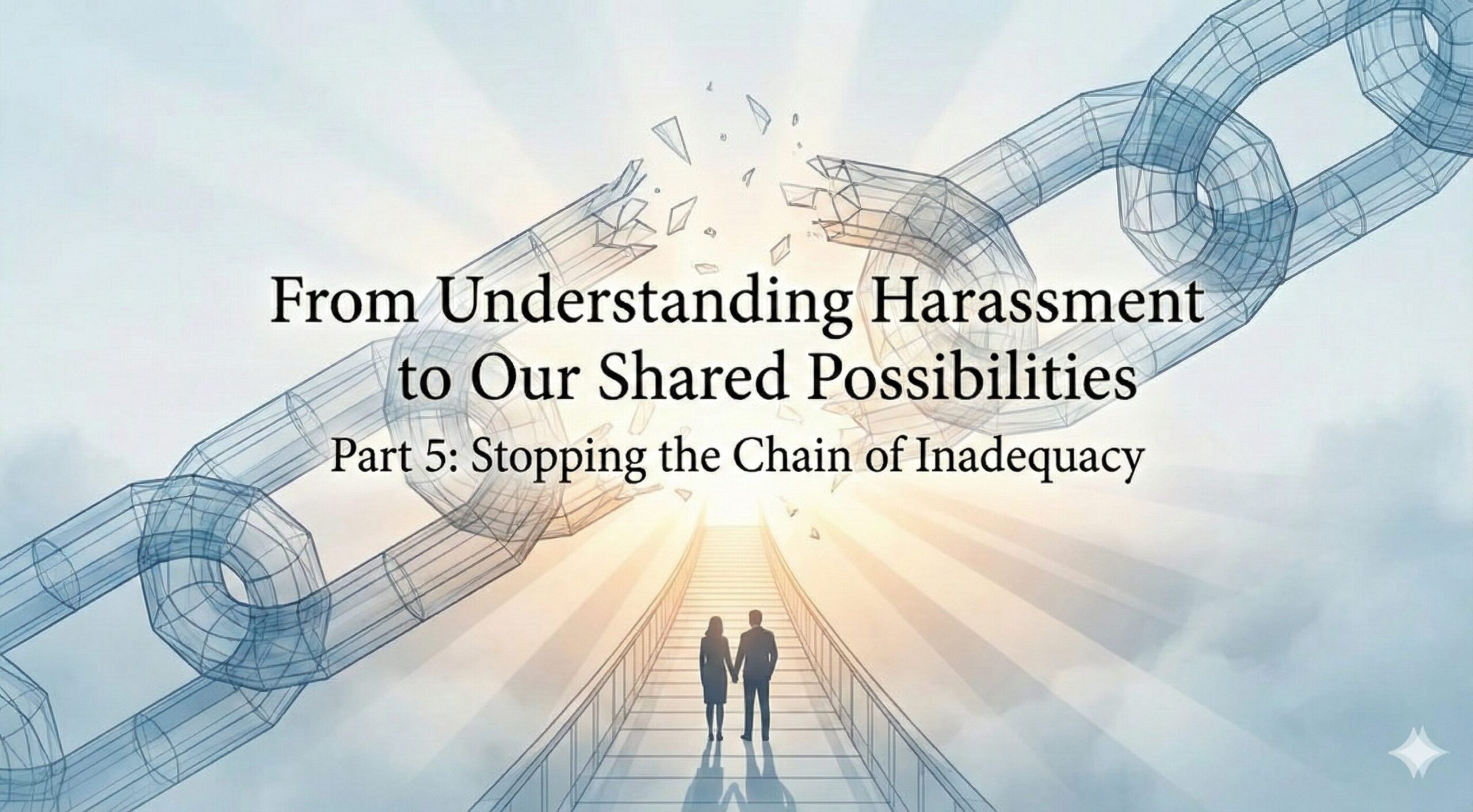
From Understanding Harassment to Our Shared Possibilities
— Stopping the Chain of Inadequacy
From Understanding Harassment to Our Shared Possibilities
— Stopping the Chain of Inadequacy
Throughout this series, we have seen that harassment is not merely a matter of inappropriate behavior.
It is a process—one in which unresolved Inadequacy is displaced onto others through relationships.
In this final article, I would like to clarify what becomes possible once we understand this process—and how we can stop the chain of Inadequacy from continuing.
Harassment as a Chain, Not an Isolated Act
One of the most overlooked aspects of harassment is its continuity.
When a person is subjected to harassment, the harm does not end with the interaction itself.
Because harassment operates at the level of Being, it undermines self-trust and internal orientation.
As a result, many victims come to believe:
- “There must be something wrong with me.”
- “I am the problem.”
- “If I were better, this wouldn’t have happened.”
In other words, the perpetrator’s Inadequacy is silently transferred to the victim.
This is the moment when the chain begins.
When Inadequacy Is Internalized
Once Inadequacy is internalized, people lose their internal reference point.
They begin to rely excessively on external norms, evaluations, and authority.
This is why individuals who have experienced harassment—especially in childhood or early professional life—are statistically more likely to encounter further harassment later on.
More troubling still, some eventually come to reproduce the same patterns, directing similar pressure or control toward others.
Not because they are malicious,
but because they have learned no other way to manage Inadequacy.
This is how harassment perpetuates itself—not through evil intent, but through unrecognized transmission.
Why Knowledge Matters: Becoming Literate in Inadequacy
Stopping this chain does not begin with moral condemnation.
It begins with becoming literate in Inadequacy.
What is required is a shift from:
- blaming individuals
to - recognizing relational mechanisms
When we understand that:
- Inadequacy often seeks relief through control
- Norms and “rightness” can be used as cover
- Double binds trap people psychologically
we gain the ability to say:
“This feeling does not belong to me.”
That recognition alone can interrupt the chain.
From Individual Coping to Social Responsibility
Traditionally, the burden of coping has been placed on victims:
- “Be stronger.”
- “Set better boundaries.”
- “Learn to endure.”
But harassment is not a personal failure.
It is a relational failure.
Stopping the chain of Inadequacy requires:
- refusing to absorb what is not ours
- challenging local rules that disguise personal insecurity
- keeping interactions at the level of Doing, not Being
This is not only personal work—it is a collective responsibility.
The Role of Humanistic Knowledge
The kind of understanding required here cannot be reduced to checklists or compliance manuals.
It demands a form of knowledge that asks:
- How do humans relate?
- How does power distort responsibility?
- How does meaning collapse under coercion?
This is why humanistic perspectives—long sidelined in favor of surface-level guidelines—are once again essential.
Not as abstract philosophy,
but as practical wisdom for living together.
Our Shared Possibilities
When the chain of Inadequacy is stopped, something profound becomes possible.
- Relationships regain flexibility
- Learning resumes
- Trust can be rebuilt
- Diversity becomes workable rather than threatening
Understanding harassment, then, is not only about protection.
It is about reclaiming the conditions under which people can remain themselves—without being forced to carry another person’s unresolved Inadequacy.
This is the possibility that opens when we truly understand harassment.