How Harassment Takes Shape
— Understanding the Mechanism Through Everyday Examples
In the previous article, I explained the structural definition of harassment.
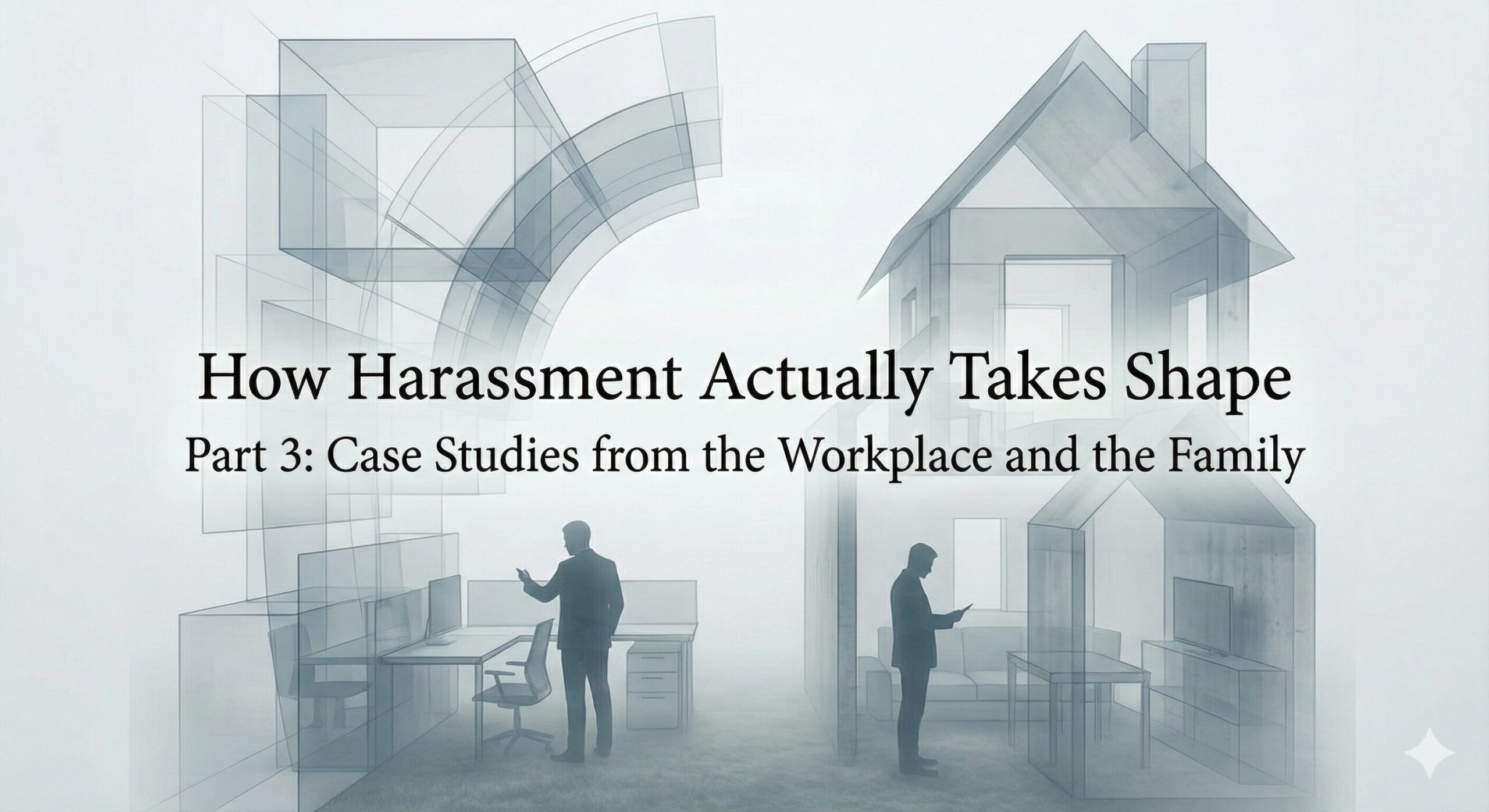
In this article, I will show how that structure actually unfolds in real-life relationships, using two common examples: the workplace and the family.
Case 1: Harassment in the Workplace
Let us begin with a situation many people recognize.
Step 1: Unresolved Inadequacy
A supervisor carries unresolved Inadequacy—inner insecurity, anxiety, or instability.
Rather than addressing this internally, the supervisor seeks to manage it through control.
Step 2: Disproportionate Criticism
A subordinate makes a minor mistake.
The supervisor responds by harshly reprimanding them.
The subordinate acknowledges the mistake. Minor errors do happen in busy workplaces, and there are often multiple acceptable ways to perform a task.
At the same time, the subordinate feels that the reaction is excessive—something does not quite add up.
Yet, because this is a workplace, the subordinate feels compelled to listen.
One must accept guidance, take responsibility, and improve. This sense of obligation draws them in.
Step 3: Escalation and Denial of Perception
The supervisor escalates:
“You don’t show any reflection.”
“You’re always making mistakes.”
Here, the supervisor denies the subordinate’s perception and frames the situation as a moral or personal failing.
This surface-level justification masks the supervisor’s own Inadequacy.
The subordinate feels confused and distressed.
However, openly resisting could be interpreted as having a bad attitude. So again, they comply.
Step 4: Psychological Constraint
The supervisor continues:
“At this rate, I can’t entrust you with real work.”
“You’ll never become fully competent.”
Repeated appeals to responsibility and competence—combined with contradictory emotional signals—create a psychological trap.
The subordinate begins to doubt their own judgment and loses confidence.
This is where a double bind quietly takes effect:
no response feels correct, yet withdrawal feels impossible.
Step 5: Secondary Harassment
Sensing something is wrong, the subordinate seeks advice.
They are told:
“Maybe your attitude is the problem.”
“That’s just how companies are.”
At this point, the situation is complete.
The subordinate begins to believe: I must be the one who is wrong.
As this cycle repeats, the subordinate gradually loses trust in their own perception and internalizes the supervisor’s standards—absorbing the supervisor’s Inadequacy as their own.
Case 2: Harassment in the Family
A similar mechanism appears in parent–child relationships.
Step 1: Parental Inadequacy
A parent, burdened by their own Inadequacy, feels irritable and unstable.
Step 2: Authoritative Demand
The parent scolds the child for playing:
“Go study.”
The child protests:
“Why can’t I play?”
This reaction reflects a natural sense of unfairness.
Step 3: Moral Coating
The parent responds:
“I’m saying this for your own good.”
The child becomes confused.
Intuitively, the child senses that the parent’s irritation is not truly about studying—but is told it is care and responsibility.
Here again, contradictory messages operate beneath the surface.
Step 4: Internalization
The parent continues:
“You never listen.”
“You’re not obedient.”
The child feels frustrated, yet gradually concludes:
I must be a bad child.
The child’s desire to maintain the relationship draws them further into self-blame.
Step 5: Reinforcement from Others
When the child seeks reassurance, they are told:
“That happens in every family.”
“You should try harder.”
Over time, the child stops trusting their own feelings.
What These Examples Reveal
Across both cases, the same structure appears:
- Inadequacy beneath the surface
- Plausible justifications on the surface
- Contradictory messages that restrict psychological movement
- Reinforcement through surrounding relationships
Harassment does not require extraordinary cruelty.
It emerges quietly within ordinary relationships.
This is why harassment often goes unnoticed—especially when it is unnamed.
“Society Is Made of Harassment”
At this point, some readers may feel surprised:
“Is that really harassment?”
As one Japanese scholar has observed,
“Society itself is saturated with harassment.”
When harassment occurs, people begin to doubt their own perception.
At its most severe, this process extinguishes one’s sense of self.
The Swiss psychoanalyst Alice Miller referred to this as the “murder of the soul.”
This is not an exaggeration.
When individuals lose their internal reference point, they become dependent on external norms and authority.
If this occurs early in life, it increases vulnerability to future harassment—and, tragically, may lead individuals to replicate the same patterns toward others.
Harassment is not a single act.
It is a process.
In this article, we examined how the harassment mechanism operates in concrete relationships.
In the next article, I will address the question many people struggle with:
- Where exactly does harassment begin?
- How can we distinguish harassment from necessary guidance or correction?
To answer these questions, we will organize practical criteria that can be applied in everyday situations.